
video marketing systems

Campaigns Don’t Build Brands. Systems Do.
Campaigns have their place; they can create momentum, generate attention, and support a key initiative.
But campaigns alone do not build brands.
Systems do.
When Campaigns Become the Strategy
Too often, companies treat campaigns as the foundation of their marketing rather than a component of it.
A concept is developed, a creative direction is chosen, and a significant budget is allocated. The work is launched with energy and excitement.
Then the campaign ends, and so does the momentum.
Without a larger content system in place, campaigns become isolated bursts of activity rather than part of a sustained trust-building effort.
In some cases, they drift even further off course. Campaigns can become more about creative experimentation or industry recognition than about serving customers. The focus shifts toward what might win awards rather than what will create clarity and value for the audience.
That disconnect is where brands lose traction.
Campaigns Should Complement, Not Confuse
A well-executed campaign should feel like a natural extension of your existing messaging.
It should:
Align with your positioning
Reinforce your brand voice
Support your broader marketing objectives
Provide meaningful value to your audience
When a campaign feels disconnected from your ongoing communication, it creates confusion. Customers begin to question what the company truly stands for.
Consistency builds trust, and then confusion erodes it.
That consistency only happens when campaigns are built on top of an established system.
The Role of a Content System
A content system creates structure around:
Who you’re speaking to
What you consistently stand for
How your executive team shows up
How value is delivered over time
How content is produced and distributed
When that infrastructure is in place, campaigns become strategic accelerators rather than standalone events.
Instead of inventing something entirely new every quarter, campaigns emerge naturally from the ongoing content you are already producing. They amplify a message that has already been reinforced. They highlight themes your audience already understands.
The result is cohesion instead of chaos.
Why Systems Win Long-Term
Brands are not built in bursts.
They are built through steady, aligned visibility.
A system ensures that:
Messaging remains clear
Content remains consistent
Executive leadership remains visible
Marketing efforts remain integrated
Campaigns can drive attention. Systems build reputation.
Campaigns can create spikes. Systems create compounding trust.
When companies commit to building infrastructure first, defining their audience, clarifying their positioning, and creating repeatable content processes, campaigns become far more effective.
Without that foundation, they are simply noise.
The Better Approach
Campaigns are not the enemy. They can and should be part of a healthy marketing ecosystem.
But they should never be the ecosystem.
Build the system first.
Create consistent value. Establish clarity. Align video with your broader marketing strategy. Develop repeatable production processes.
Then allow campaigns to emerge from that structure, not replace it.
In the long run, brands that invest in systems do not need to rely on constant reinvention.
Their credibility compounds.
And that is what truly builds a brand.

If Your CEO Isn’t Visible, Your Company Becomes Discounted
In every industry, authority drives trust.
And in most organizations, the greatest concentration of authority is at the top.
Your CEO, along with your executive team, likely holds the deepest insight into your market, your customers, and your company’s long-term vision. They are in that role for a reason. They bring experience, perspective, and clarity in decision-making that no one else in the organization can fully replicate.
When that expertise remains invisible, the brand loses leverage.
Visibility Signals Leadership
Buyers evaluate risk before they evaluate price.
When executive leadership is absent from public view, potential clients are left to interpret the brand without a clear voice behind it. They see services. They see products. They may see marketing.
But they do not see leadership.
Executive visibility does more than promote a personality. It communicates:
Confidence in direction
Depth of expertise
Commitment to transparency
Stability within the organization
When a CEO or owner consistently shares insight, perspective, and industry understanding, it positions the company as a leader, not a participant.
Without that visibility, the company is easier to question, overlook, and discount.
Authority Should Be Seen, Not Assumed
Many executives assume their authority is implied. It is not.
In today’s environment, leadership must be visible to be trusted. Prospective clients want to understand how leaders think. They want to see the faces behind decisions. They want clarity around values and direction.
When executives speak directly to the market, thoughtfully and consistently, they accelerate trust. They shorten sales cycles. They elevate brand perception.
This does not require constant performance or overwhelming production schedules.
It requires structure.
Systems Prevent Executive Overwhelm
The common objection is time.
CEOs and C-suite leaders are busy. Their calendars are full. Adding “content creation” to their workload can feel impractical.
This is where systems matter.
When a structured process exists:
Filming is scheduled intentionally
Messaging is clarified in advance
Production days generate multiple assets
Distribution is handled strategically
Executive involvement is focused and efficient
Instead of being disruptive, visibility becomes integrated into the rhythm of leadership.
The goal is not to turn executives into influencers.
The goal is to capture, refine, and distribute their existing expertise in a repeatable way.
Putting a Face to Trust
Brands do not build trust in isolation. People build trust.
When your audience consistently sees and hears from leadership, they begin to associate your organization with clarity, competence, and credibility. Over time, that visibility compounds. Familiarity grows. Confidence strengthens.
The company stops competing on price and begins competing on authority.
The Strategic Advantage
Executive visibility is not a vanity play.
It is a strategic advantage.
Organizations that intentionally position their leadership in front of their audience, through structured, consistent video systems, create differentiation that competitors struggle to match.
If your CEO is invisible, your company is easier to undervalue.
When leadership is visible, aligned, and consistent, your brand becomes harder to ignore and harder to discount.

Internal Storytelling Reduces Friction and Turnover
Every organization has a story.
The question is whether that story is being told intentionally or left to interpretation.
Internal storytelling is often overlooked in favor of external marketing efforts. Yet for many companies, it may be one of the most strategic investments they can make.
When done well, it reinforces culture, strengthens alignment, and reduces the kind of internal friction that leads to disengagement and turnover.
If You’re Not Telling the Story, Someone Else Is
Inside every company are daily moments that define its culture:
Team wins
Customer breakthroughs
Leadership decisions
Acts of integrity
Collaboration across departments
These moments shape how employees experience the organization.
If they are not captured and reinforced, they fade quickly. Informal narratives take their place. Culture becomes assumed rather than articulated.
Employees should absolutely be part of telling the story. But without structure and documentation, the story becomes fragmented.
A thoughtful internal video strategy brings clarity and cohesion.
Culture Is Reinforced Through Visibility
A strong culture does not sustain itself automatically. It requires reinforcement.
Internal storytelling through video can:
Celebrate wins publicly
Recognize individuals and teams
Highlight values in action
Document growth and milestones
Clarify mission and direction
When employees see their contributions acknowledged and their work connected to a larger mission, engagement increases.
They feel seen, valued, and a part of something larger than their individual role.
That sense of belonging directly impacts retention.
Micro-Stories Matter
Most powerful internal stories are not dramatic brand films.
They are the micro-stories found in daily business:
A technician solving a difficult problem
A sales leader mentoring a new hire
A department collaborating under pressure
A milestone achieved through persistence
These moments deserve to be documented.
When captured consistently, they create an internal archive of identity, a living record of what the organization stands for and how it operates.
Over time, this documentation strengthens unity and reduces friction across teams.
Reducing Turnover Through Alignment
Turnover is costly, financially and culturally.
Often, it stems from misalignment. Employees feel disconnected from leadership, unclear about the mission, or unrecognized for their contributions.
Intentional internal storytelling addresses those gaps.
When leadership communicates clearly.
When wins are celebrated.
When values are demonstrated rather than merely stated.
Employees are more likely to remain engaged and committed in the long term.
Video becomes more than a marketing tool. It becomes a cultural asset.
An Investment in Longevity
It is surprising how few organizations invest meaningfully in telling their internal story, especially through video.
Companies invest heavily in customer acquisition. They allocate budgets for advertising, campaigns, and external brand awareness.
But the internal audience, the people building the brand every day, often receives less strategic attention.
Organizations that take internal storytelling seriously create:
Stronger culture
Greater transparency
Deeper loyalty
Lower friction
Reduced turnover
When culture is visible and consistently reinforced, it compounds, just like external trust does.
Internal storytelling is not a secondary initiative.
It is infrastructure for long-term stability and growth.
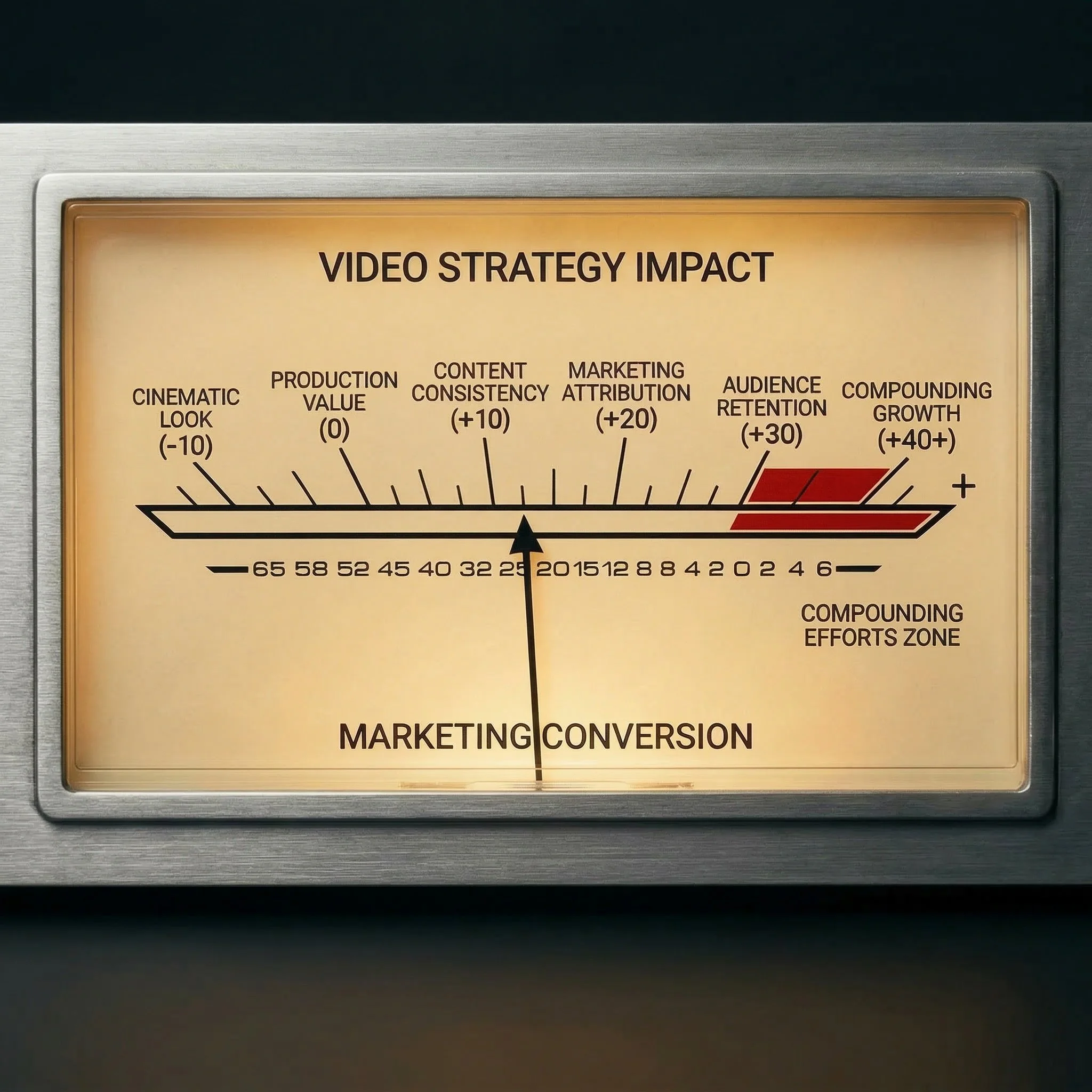
We Build Infrastructure, Not Content
Anyone can create content.
The tools are affordable. The platforms are free to use. The demand for video is unquenchable.
But content alone does not create momentum.
Infrastructure does.
The Difference Between Activity and Advantage
Many organizations are producing video content. Fewer are building systems that allow content to compound.
There is a huge difference between:
Posting videos out of obligation
Building a structured ecosystem where video fuels trust, supports sales, and strengthens internal alignment
Content for content’s sake is activity.
Infrastructure creates an advantage.
When systems are in place, video becomes more than a marketing asset. It becomes:
A trust-building engine
A sales enablement tool
A leadership positioning platform
An internal communication asset
A long-term brand differentiator
This happens when video production is tied to structure.
Flash-in-the-Pan vs. Compounding Visibility
Without infrastructure, video often becomes episodic.
A high-budget brand film is produced. A campaign launches. A few strong pieces go live.
Then momentum fades.
Contrast that with organizations that treat video as an ongoing system. Their visibility is not dependent on a single project or creative idea. It is sustained over months and years.
If you study successful long-term video strategies, you will notice a pattern:
They are consistent
They are structured
They serve both internal and external audiences
They are not built solely around large, one-time productions
Not every asset needs to be a $20,000 or $50,000 brand film. In fact, many of the most effective pieces are practical, educational, and value-driven.
They build trust over time.
Systems Remove the Burden
One of the biggest obstacles to consistent content is internal fatigue.
Content creation often falls on a small number of people. When the process feels overwhelming or unclear, it stalls.
Infrastructure changes that dynamic.
When systems are implemented:
Production is planned, not reactive
Multiple assets are captured from one initiative
Executive participation is structured and efficient
Distribution is intentional
Responsibilities are clearly defined
The burden is reduced. The process becomes repeatable.
More importantly, the strategy does not hinge on a single individual.
Stability Through Change
Organizations evolve. Leaders move roles. Team members transition.
Without infrastructure, content efforts often stop when the person driving them leaves.
With the infrastructure in place, the system remains intact.
The messaging continues. The visibility persists. The assets remain valuable.
The brand does not reset every time there is a change in personnel.
That is the power of building systems instead of chasing output.
A Long-Term Approach to Trust
Infrastructure allows video to do what it does best: build trust gradually and consistently.
It aligns leadership, marketing, and sales.
It reinforces positioning.
It creates tangible assets that support growth.
Content can create attention.
Infrastructure creates compounding credibility.
That is the difference between producing videos and building a strategic advantage.
At Thrasher Digital, the focus is not on simply creating more content.
It is on building the systems that allow content to work today, tomorrow, and years from now.

Why Most Companies Waste Money on Video
Video content creation has never been more accessible. The tools are better. The barrier to entry is lower. The platforms reward it.
And yet, many companies walk away from video marketing frustrated, underwhelmed, and skeptical of ever investing in it again.
The problem is not video.
The problem is the absence of structure.
Reaction Instead of Strategy
Too often, video begins as a reaction.
A trend emerges.
A prominent voice says, “You need to be doing video.”
A competitor launches a new campaign.
So a company decides to “do video.”
But there is no defined positioning. No clear audience strategy. No distribution plan. No system for consistency.
Without that foundation, even a beautifully produced video falls flat. It may look cinematic. It may feel polished. But it lacks alignment with the broader marketing strategy. Customers feel the disconnect. The message confuses more than it clarifies.
And the investment fails to build trust.
The “One Video” Trap
Another common pattern: a company invests heavily in a single project.
A production team is hired. The video is shot and edited. It looks exceptional.
And then it sits on the website.
No strategic rollout. No repurposing. No integration into a larger content engine. No measurable conversion goal.
The result? A $20,000–$30,000 asset that becomes a digital brochure rather than a business driver.
Afterward, leadership concludes that “video doesn’t work.”
In reality, the system didn’t exist.
Video Is Not a Marketing Department
It is also common to expect one videographer to serve as:
The production team
The motion graphics designer
The social media strategist
The distribution manager
The entire marketing department
Video should support a marketing strategy. It cannot replace one.
For video to produce results, it must operate alongside a defined marketing infrastructure. It should align with positioning, messaging, sales objectives, and audience insights.
When video is isolated from strategy, it becomes an expensive decoration.
When it is integrated into a system, it becomes leverage.
Trust Does Not Happen Overnight
Trust is not built with a single cinematic brand film.
It is built through consistent, value-driven visibility over time.
That requires:
Clear audience definition
Repeatable production processes
Executive involvement without executive overwhelm
A distribution plan
A long-term roadmap
When systems are in place, one production day can generate multiple assets. Interviews become thought leadership clips. Case studies become educational segments. Brand messaging becomes ongoing content.
Instead of one deliverable, you create an engine.
Where Companies Actually Save Money
Counterintuitively, structure reduces costs.
When companies:
Understand their audience
Define their positioning
Commit to long-term visibility
Work within a repeatable production framework
They stop paying for isolated projects and start investing in infrastructure.
That is when video begins to compound.
That is when marketing dollars stretch further.
That is when competitors who are still chasing trends begin to fall behind.
The Shift
Video is powerful. But it is complex. Shooting, editing, and distributing content requires coordination and expertise. Without systems, it becomes reactive and inefficient.
With systems, it becomes predictable and strategic.
The companies that win are not the ones producing the most cinematic content.
They are the ones who:
Show up consistently
Provide value intentionally
Align video with executive leadership
Build long-term trust instead of chasing short-term attention
Video should not be a vanity project.
It should be infrastructure.
And when treated that way, it stops being an expense and starts becoming an advantage.

Why We No Longer Take One-Off Video Projects
Thrasher Digital is stepping away from one-off video projects.
Not because video projects are unimportant, but because they rarely create a lasting impact on their own.
Our focus is on partnership
From Vendor to Strategic Partner
A one-off project typically follows a familiar pattern:
A company identifies a need.
A video is commissioned.
It is produced, delivered, and posted.
Then everyone moves on.
There is little discussion about performance.
Little analysis of outcomes.
Little integration into a broader system.
The work may look exceptional. The production value may be high. But without continuity and data-informed iteration, it becomes a standalone asset rather than a strategic lever.
We are no longer interested in being a vendor who completes a deliverable and disappears.
We are committed to being a partner in building video content infrastructure.
Data Should Shape Direction
Modern platforms provide measurable insights. Every video produces data:
Engagement patterns
Watch time
Audience retention
Conversion behavior
Platform-specific analytics
Yet in many project-based engagements, this information is never reviewed with intention.
The video is posted. Performance is observed, if at all, casually, and the next project begins.
A partnership model changes that dynamic.
Instead of asking, “Did the video look good?” we ask:
Did it move the needle?
Why did it perform the way it did?
What can we refine?
How does this inform the next initiative?
Strategic video should evolve over time. That evolution requires continuity.
Systems Create Momentum
One-off work often leads to sporadic visibility. Momentum starts and stops. Messaging shifts. Learning is lost between projects.
A structured partnership creates:
Clear objectives
Repeatable production processes
Aligned messaging
Ongoing performance review
Data-driven adjustments
Video becomes part of a marketing ecosystem, not a detached creative exercise.
This approach allows us to work alongside internal marketing departments and external agencies in a complementary way. Rather than replacing the strategy, we reinforce it. Rather than operating independently, we integrate.
A Smarter Alternative to Scaling Internally
Building an in-house video team can be effective, but it comes with a high cost:
Salaries
Benefits
Equipment investment
Ongoing overhead
Management time
For many organizations, the investment is substantial before performance is even proven.
A strategic partnership with Thrasher Digital provides:
Senior-level expertise
Structured systems
High production standard
Scalable capacity
Data-informed decision-making
All without the burden of prematurely expanding internal headcount.
Working With the Right Brands
This shift is also about alignment.
We want to partner with organizations that are building something meaningful. Companies that value long-term trust over short-term attention. Leadership teams that want to understand performance, not just produce output.
We are not interested in chasing trends or creating content for content’s sake.
We are interested in helping brands scale with intention.
The Difference
There are many talented production companies capable of delivering strong visuals.
Our differentiation is this:
We build systems.
We analyze performance.
We make decisions based on data.
We integrate with your marketing strategy.
We commit to a long-term partnership.
Stepping away from one-off projects allows us to focus where we are most effective, building video infrastructure that compounds over time.
Because sustainable growth does not come from isolated projects.
It comes from intentional partnership and strategic execution.